Category Archives: Glenn Wiebe

Analysis worksheets, evidence, and primary documents

loc analysis worksheetThere’s a cool buzz running through the history education world.

Primary sources. Documents. Using evidence. Solving problems. Historical thinking. And that’s a good thing. But I know that it can be difficult sometimes trying to figure out how to use primary sources.

First piece of advice?

Don’t worry so much about primary vs. secondary sources. Start thinking about evidence, about data, instead of focusing just on one sort of document over another. Because if we’re asking great questions, kids will be using all sorts of documents and sources to solve the problem.

Second piece of advice?

Don’t re-invent the wheel. Have kids use the different tools already out there as they work to make sense of documents. As we train our kids to think historically, these sorts of analysis worksheets can be great scaffolding tools, especially with  elementary and middle school students.

Some of the best Continue reading Analysis worksheets, evidence, and primary documents →

#NCSS13 in St. Louis, Missouri

Greetings from the “Show Me” State!

I happen to be at the premiere social studies education event in the country.  Approximately 2500 social studies educators, professors, and exhibitors have crowded the St. Louis America Convention Center for the annual conference of the National Council for the Social Studies.  I always look forward to this event and find it to be one of energy and it recharges my batteries after I hit the Fall Doldrums of the School Year.

It is also exciting for me.  My hotel is literally a stone’s throw from the arch and the Edwards Dome where the Rams play.  I walked to the conference last night in the rain, mist, and fog and in looking up, the upper half of the arch was covered.  It was beautiful.  Continue reading #NCSS13 in St. Louis, Missouri →

A whole bunch of History Twitter feeds

Okay, I may have done the math wrong. But whatever the number is, it’s a bunch of very cool and useful Twitter feeds. Grab a couple or three of them and expand your Personal Learning Network.

A quick and easy way to grow your list is to check out who these users are following. In no time, you’ll have tons of links to tons of stuff.

And be sure to scroll down for some basic info on using hashtags! Continue reading A whole bunch of History Twitter feeds →

Teaching with movies

Several years ago I wrote a post titled “10 Movies Every Social Studies Should See.” Of course, I added some extra bonus movies. I love movies and am convinced that using short video clips from featured length movies in the classroom is a good idea.

And, yes, I’m probably encouraging the stereotype of social studies teachers / coaches showing movies every week so that they can read the newspaper, break down game film, or drink coffee. But I will always argue that appropriate use of video clips and movies is great for kids.

So some resources to help break the stereotype: Continue reading Teaching with movies →

Graphic notes, primary sources, and literacy skills

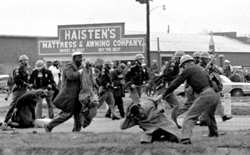
bloody-sunday-2It seems like every social studies teacher I talk to asks about reading and writing strategies. Everyone is freaking about Common Core ELA literacy skills for history / government. And I suppose that’s a good thing. Good social studies instruction should always include reading and writing activities.

But I believe that we sometimes over-think the whole process. Give kids engaging questions, provide some interesting evidence, and step out of the way. An easy way to focus on document analysis and support writing skills is something I call Graphic Notes. I posted this on History Tech several weeks ago but I like it so much, I decided to post here as well!)

A Graphic Note is a lot like a Thought Bubble but takes it a bit further. So you can use it as a hook activity or even as a type of assessment.

1. Start by  Continue reading Graphic notes, primary sources, and literacy skills →