Category Archives: Glenn Wiebe

Trading Cards, ReadWriteThink, and the Common Core

trading card 1We’ve always asked our kids to read. Informational text. Primary sources. Non-fiction. Fiction. Poetry. We’ve always asked our kids to write. Summaries. Research. Reviews. Reaction papers.

At least, that’s been the theory. Good social studies and history instruction has always included these things but I think that sometimes we can forget how critical reading and writing skills are to what we do. The Common Core, for better or worse, has been a good reminder for us. We need to have our kids read, write, and communicate much more.

The problem for many of us?

Uh . . . what does that look like again?

Continue reading Trading Cards, ReadWriteThink, and the Common Core →

Using elementary Evidence-Based Terms in social studies classrooms

evidence-based-terms2As we move into a social studies world that is asking kids to collect evidence, organize evidence, create products, and communicate results, writing skills are becoming more and more important.

But for the last ten years or so, at least in the state of Kansas, we’ve asked kids to focus instead on memorizing content. So now when we’re asking our middle school and high school students to not just write more but to use evidence while proving assertions, we get a lot of blank stares.

My suggestion?

Steal a practice used by a lot of elementary teachers and start training your secondary kids to use evidence-based terms while writing.

Evidence-based terms are simple phrases that support the use of, well . . . evidence. So if we ask kids to look a couple of primary source documents and develop a thesis from their analysis, they have some scaffolding to help them do that.

Examples of evidence-based terms? Continue reading Using elementary Evidence-Based Terms in social studies classrooms →

Sweet Sochi 2014 Winter Olympic lesson plans and instructional goodies

Sochilogo

Are you looking for some sweet Sochi 2014 Winter Olympic instructional goodies? Here’s what I’ve got:

Start with the basics

News

Social Media

Mobile Apps
(I’m part of Team Apple so . . . these are iPhone / iPad apps. I did some checking – Google Play and Android also have tons.)

Lesson Plans / Instructional Materials

Have fun!

Disc vs. Plow: Social Studies in the 21st Century

I grew up in western Kansas. Land of giant jack rabbits. Tumble weeds. Beautiful sunsets. Vast horizons. And wheat. Lots of wheat.

I spent a lot of time on the family farm in the northeast part of Finney County. Much of the land was broken out by my grandmother’s father and uncles around the turn of the century. Growing up, my brothers and I rode trucks, tractors, and combines, climbed windmills, fell off windmills, walked miles of fields, hunted pheasants, raced motorcycles, and generally had a great time.

As we got older, we drove the trucks, tractors, and combines – planting and harvesting wheat and milo.

The point? Continue reading Disc vs. Plow: Social Studies in the 21st Century →

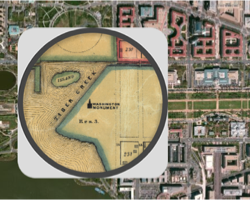
Interactive maps compare current cities to 19th century versions

dc-spyglass-viewI love the Smithsonian magazine. Both the print and online versions. The articles are incredibly cool and range all over the place, from why we incorrectly believe that carrots help us see better to what people snacked on during the 1963 March on Washington.

During a recent run through their online history articles, I ran across a very cool interactive activity that lets you look at past and present maps of six major US cities. The magazine recently dipped into David Rumsey‘s collection of over 150,000 maps to find some of the best representations of American cities over the past couple hundred years. With some simple programming, they were able to overlay images of vintage maps of some major cities onto satellite images from today. Continue reading Interactive maps compare current cities to 19th century versions →