Category Archives: graphic organizer

Using elementary Evidence-Based Terms in social studies classrooms

evidence-based-terms2As we move into a social studies world that is asking kids to collect evidence, organize evidence, create products, and communicate results, writing skills are becoming more and more important.

But for the last ten years or so, at least in the state of Kansas, we’ve asked kids to focus instead on memorizing content. So now when we’re asking our middle school and high school students to not just write more but to use evidence while proving assertions, we get a lot of blank stares.

My suggestion?

Steal a practice used by a lot of elementary teachers and start training your secondary kids to use evidence-based terms while writing.

Evidence-based terms are simple phrases that support the use of, well . . . evidence. So if we ask kids to look a couple of primary source documents and develop a thesis from their analysis, they have some scaffolding to help them do that.

Examples of evidence-based terms? Continue reading Using elementary Evidence-Based Terms in social studies classrooms →

The Dreaded Textbook

I would almost be willing to bet money on the fact that my student’s least favorite part of my class is when I say “grab your textbooks.”  The groans that echo around the room are enough to keep me from repeating that phrase very often, but I know my kids still need to learn how to use their textbooks, so I brave the sound effects every now and then.  What my students dread most is opening the book and silently reading hundreds of pages (or at least it feels like that many to them), so I try to find fun reading strategies to alleviate the amount of reading while still ensuring my kids are getting the information they need. Continue reading The Dreaded Textbook →

Analysis worksheets, evidence, and primary documents

loc analysis worksheetThere’s a cool buzz running through the history education world.

Primary sources. Documents. Using evidence. Solving problems. Historical thinking. And that’s a good thing. But I know that it can be difficult sometimes trying to figure out how to use primary sources.

First piece of advice?

Don’t worry so much about primary vs. secondary sources. Start thinking about evidence, about data, instead of focusing just on one sort of document over another. Because if we’re asking great questions, kids will be using all sorts of documents and sources to solve the problem.

Second piece of advice?

Don’t re-invent the wheel. Have kids use the different tools already out there as they work to make sense of documents. As we train our kids to think historically, these sorts of analysis worksheets can be great scaffolding tools, especially with  elementary and middle school students.

Some of the best Continue reading Analysis worksheets, evidence, and primary documents →

How I use “Discrepant Event Inquiry” in my classroom

A few years ago, I was introduced to “Discrepant Event Inquiry” from Glenn Wiebe. (Here is another post about it from his History Tech blog). The idea is that you take an image and only reveal a little bit at a time. As I reveal a little bit of the picture, the students must guess Who is in the picture, What is happening, When was the photograph taken, and Where is this taking place. This encourages students to think outside the box and it also does WONDERS with questioning and how to ask the right questions. Naturally, I turned this into a competition. Continue reading How I use “Discrepant Event Inquiry” in my classroom →

Graphic notes, primary sources, and literacy skills

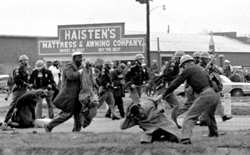
bloody-sunday-2It seems like every social studies teacher I talk to asks about reading and writing strategies. Everyone is freaking about Common Core ELA literacy skills for history / government. And I suppose that’s a good thing. Good social studies instruction should always include reading and writing activities.

But I believe that we sometimes over-think the whole process. Give kids engaging questions, provide some interesting evidence, and step out of the way. An easy way to focus on document analysis and support writing skills is something I call Graphic Notes. I posted this on History Tech several weeks ago but I like it so much, I decided to post here as well!)

A Graphic Note is a lot like a Thought Bubble but takes it a bit further. So you can use it as a hook activity or even as a type of assessment.

1. Start by  Continue reading Graphic notes, primary sources, and literacy skills →