Category Archives: best practice

Dueling Timelines: Combining “Big Events” and “Big Ideas”

As we are currently in the midst of coaching clinic, teacher workshop, and summer institute application season, time always seems to be lacking.  That is partly why I am taking the easy way out by showing the slides of a portion of a presentation I gave in New Orleans in 2015 on innovative uses of classroom space.

This section of that presentation presents an option for using two timelines, uniformly color-coded based on unit, to help students simultaneously grasp the chronological progression of events and see how the relationship between ideas and historical agents are dynamic and ever evolving.

Please leave a comment if you have any questions or thoughts, or if you would like more information on this lesson application!

Continue reading Dueling Timelines: Combining “Big Events” and “Big Ideas” →

Argumentative writing prompts, scaffolded tasks, and using evidence

citation-neededWe want our students to grapple more with content, to think historically, and solve problems. One of the ways we can support this behavior is by asking our kids to think and write to support a claim using evidence.

Here in the great state of Kansas University basketball, our standards and assessment use the term “argumentative writing” to describe the process of supporting claims with evidence. That phrase can sound a little too much like some of last  year’s presidential debates or this month’s childish Twitter wars but . . . asking kids to create an argument and to support that argument really is a good thing. We want them to be able to look at a problem, gather and organize evidence, and use that evidence to create a well-supported argument.

As many of us move from a content focused instructional model to one that instead asks students to use that content in authentic ways, it can sometimes be difficult knowing how to actually have them write argumentatively. But there are resources available to help with your lesson design.

We’ve gone back to an earlier post from our partner blog History Tech to cherry pick some of our favorites. Pick and choose the ones that work best for you. Continue reading Argumentative writing prompts, scaffolded tasks, and using evidence →

Civic Engagement & Historical Argumentation

adam-topliff

This week’s author is Adam Topliff: I teach 8th Grade Social Studies & Civics at Wamego Middle School in Wamego, KS.  I love all things Hamilton!

———

The Kansas Standards for History, Government, and Social Studies prepare students to be informed, thoughtful, engaged citizens as they enrich their communities, state, nation, world, and themselves.

The mission statement for our HGSS standards in Kansas has pushed educators across disciplines to consider how we are working to get our kids engaged.  This push is part of the greater initiative to deliver the best education in the nation and to produce true 21st Century citizens. One of the main focuses at KSDE is the idea of creating civic engagement for our students. This can be demonstrated through any number of opportunities in which our students engage in community service, leadership initiatives, or simply study how our government works. However, we must consider how to encourage civic engagement as we study history.

One of the staples of the mission statement is “engaging to provide the enrichment to a student’s communities, state, nation, world and THEMSELVES.” To produce deep levels of civic engagement, we need to ask our students to engage in historical conversations based on questions that will also enrich them and challenge them to look at today’s civic, political, and social issues. To simply study the past will not develop these opportunities.  

This fall, as part of my attempt to develop better connections between the study of history and civic engagement, my students completed a long term project that asked them to evaluate the presidential job performance of the “Founding Presidents.”  One of the main curriculum units we study is the Constitution Period but  I relabeled it “Building A Nation” and used that theme to develop the presidential evaluation project.   Continue reading Civic Engagement & Historical Argumentation →

Interact sims and lesson plans get two thumbs up

Today’s guest is Megan Neiman, a high school social studies teacher at McPherson High School in McPherson, Kansas and the current secretary for the Kansas Council for the Social Studies.

———-

You know those big orange SOCIAL STUDIES SCHOOL SERVICE catalogs that social studies teachers around the country receive a few times a year? The ones that we always thumb through and think “oh, that looks nice,” and “that looks like an interesting video!”

You know the ones I’m talking about. Well, I actually tried something from it! The curriculum is called Interact and I’ve had some wonderful experiences over the past few years implementing it in my classrooms.

What is Interact?

Interact is a curriculum designed to let students learn through experiences. It’s written by teachers for teachers and closely follows the old proverb, “Tell me and I’ll forget; show me and I may remember; involve me and I’ll understand.” In a series of different units, students compete in challenges, follow simulations, and participate in assessments that help them develop skills across the curriculum and enhance the use of cooperative learning.

Each unit comes in a different book and contains anywhere from three to 20 class periods of activities. Interact supplements learning so students actually remember content because they are involved in their learning. Each book contains a teacher’s guide, purpose and overview, daily lesson plans, student materials, time management guidelines, and support materials. Interact activities require students to analyze tasks and evaluate how to apply their knowledge to create the assigned product. Most units also have activities that can be enhanced by participation from parents, administrators, or community members. This is great for promoting civic engagement and a connection to the community.

How do I use it in the classroom?

Continue reading Interact sims and lesson plans get two thumbs up →

“The Anti-Washington”: Using Art as a Historical Tool in World History Class

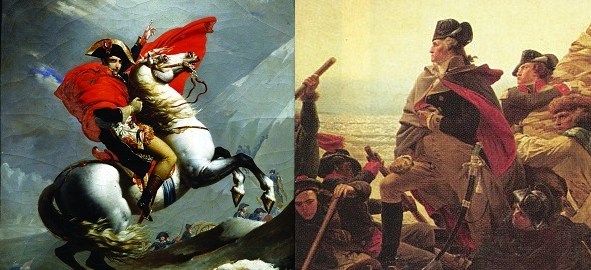
I believe that a key aspect of “doing” social studies is to give kids the opportunity to not only connect prior knowledge to the content being studied, but also allow them the chance to reevaluate their opinion of historical figures using new knowledge that is presented.  Teaching high school world history normally involves introducing students to a wide range of individuals, concepts and events.  Trying to help students achieve some level of mastery of these concepts can seem daunting, especially if you are not able to tap into that reservoir of knowledge that the kids bring with them into the room.  In teaching the French Revolution and its aftermath I attempt to achieve this by bringing in the single historical figure in which kids are the most familiar: George Washington.  In the process I also give the students a chance to flex their non-text discipline specific literacy muscles by analyzing two pieces of art work that say an awful lot about the subjects of depicted in each.

Continue reading “The Anti-Washington”: Using Art as a Historical Tool in World History Class →