Category Archives: lesson plans

MBQs – Using Media Based Questions to support historical thinking

reece-1I was having a conversation with my two twenty-something children a few weeks ago and referenced an old Reese’s Peanut Butter Cup commercial. You know the one.

The one where two people, one eating peanut butter and the other chocolate, bump into each other? The one where they’re both heading headphones, listening to their Sony Walkmans, and don’t see each other until it’s too late.

“Hey! You got peanut butter on my chocolate.” “Hey! You got chocolate in my peanut butter.”

Yeah. My kids obviously didn’t remember either. It’s an ancient ad but I think of it often when we’re talking about app mashups and tweaking tech tools to do things they’re not really designed to do. Cause chocolate and peanut butter is as delicious together as is iMovie and Tellagami.

I shared the Reece’s reference with my kids because earlier in the day I had spent some time talking Google tools with a group of tech integration coaches. Part of that time was spent exploring the possibilities of mashing up Google My Maps and Forms. And over the last few days, my brain has been going back to different things that we could be doing with Google Forms.

So.

I love document based questions. I love the Stanford History Education Group’s Beyond the Bubble mini-assessment tool. And we know that I love the Google.

The mashup? Continue reading MBQs – Using Media Based Questions to support historical thinking →

Professional Growth and Development: The Monticello Teacher Institute

Joe Zlatnik is an 8th Grade American History teacher at Basehor-Lindwood USD 458.

monticello_2010-10-29

“I am as happy no where else and in no other society,” Thomas Jefferson once wrote, “and all my wishes end, where I hope my days will end, at Monticello.”

Professional development opportunities, when relegated to our buildings, is often dull, not specific to our content, and, worst of all, uninspiring. Fortunately, there are a number of quality professional development opportunities for Social Studies teachers that will significantly impact us as educators. Coming up in November is the Kansas Council for the Social Studies Conference in Salina. The next month, the National Council for the Social Studies will have their annual conference in Washington D.C. While both of these are great opportunities to learn from some of the brightest minds in our profession, there are other professional development opportunities that are impactful on a more personal level.

This past July, I had the honor and privilege of being selected to take part in the Monticello Teacher Institute: The Barrringer Fellowship. This weeklong experience allowed me to spend time in Charlottesville, Virginia immersing myself in the world of Thomas Jefferson. We spent time at Monticello itself, the special collections library at the University of Virginia, the Robert H. Smith International Center for Jefferson Studies, and a multitude of locations significant to Jefferson’s life or the study of his life. Continue reading Professional Growth and Development: The Monticello Teacher Institute →

Using Gapminder’cool data to create compelling questions

gapminder logo

Gapminder is an organization promoting sustainable global development by encouraging the use and understanding of statistics and other information about social, economic and environmental development at local, national and global levels.

Basically it’s a tool you and kids can use to compare and contrast countries around the world. So . . . teaching geography, world history, economics, comparative government? GapMinder is a tool you and your kids need to be using.

At GapMinder, you can access a variety of tools, lesson plans, and videos that help students understand the world and can help you generate a wide range of problems for your kids to solve.

One example of a lesson plan that uses GapMinder data can help your kids to think about the gaps in the world today and challenge their preconceived ideas about how the contemporary world looks. The exercise can also be used to stimulate an interest in using statistics to understand the world.

How to use the activity: Continue reading Using Gapminder’cool data to create compelling questions →

Countdown to the Election – In the classroom

An election year is like catnip for social studies teachers: our content in action, teachable moments galore . . . but then you get a race that’s unlike any in our lifetime. Granted, the United States has had elections as contentious before (in the 19th century, multiple times) but that doesn’t make this year’s election any easier to teach. Tonight we’ll all have front row seats as the candidates meet face to face in what promises to be an interesting debate. This also means that we’ve been getting lots of lists of election year resources, but what do they look like in practice? Here’s just a glimpse of what I’ve been doing in my 8th grade U.S. History classroom (but could definitely be used in multiple grade levels).  

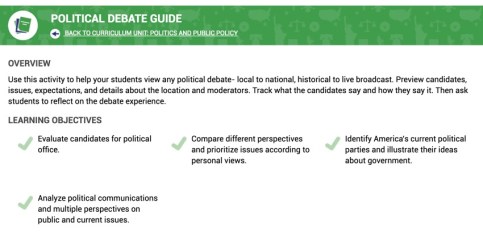
icivics-debateI’ll be sending my kids home with the kids home with iCivics’ Political Debate Guide this evening and there will be two more debates after tonight if you want to get your kids watching. Can I say how much help iCivics has been this year? It’s not just good for the games, I’ve been loving their Politics and Public Policy and Government and the Market units.
The Politics unit has lessons that break down a political process that can be confusing into understandable pieces and doesn’t leave out the media’s role. As focused as elections can be on the economy, lessons from the Market unit went along way to help me explain taxes and our federal budget. But the iCivics game Win The White House was hit after all the facts and figures. Just about all the kids got the correct answer for the number of electoral college votes required to win the presidency on my elections test.

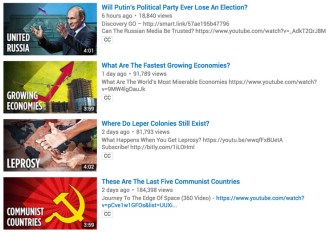
seeker-youtubeI also supplemented the above with Seeker Daily explainer videos on the candidates and parties. If you haven’t used Seeker Daily videos yet I highly recommend them. They’re all around three minutes long and explain matters both foreign and domestic – a great companion for CNN Student News. When CNN Student News has a story that I feel the students could use a little more background on, I go to Seeker and can usually find something that will clarify the issue. What is the difference between Sunni and Shiite Muslims? Got it. Why does Russia hate the United States? Yup. If you don’t use CNN Student News on a regular basis I would recommend them on Fridays. Beside all the regular election coverage they’ve had a series on Fridays focused on the election in general: electoral college, battleground states, history of televised debates…good stuff.

I hope this helped a little. We may not agree with everything the candidates are saying, but you can’t deny that they have the kids’ attention. We need to do what we can to capture this interest and hopefully create some engaged citizens in the process.  

Serious about Serial

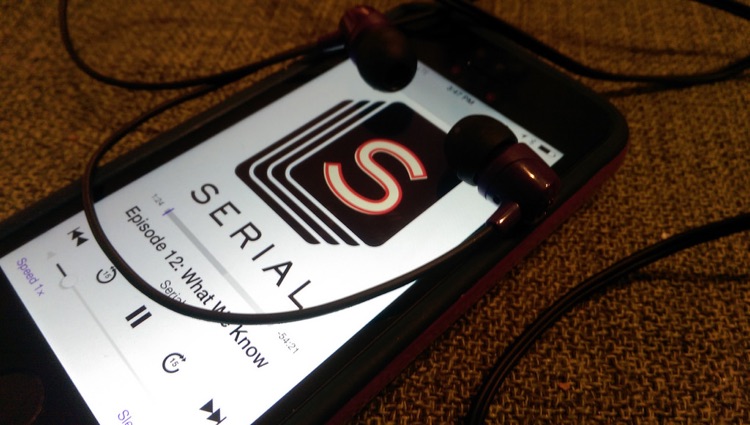
serial-podcastI come from the world of middle schoolers. I spent six years teaching ancient history to 6th graders and American history to 8th graders. So it was a shock to many of my colleagues when I decided to make the jump from tweens to teens last year.

After going through a mixture of emotions about my content change, I was so excited when I received my course load. American history (Yay! I can pick up where I left off!) and an elective – Sociology. I feel that Sociology is a dream class for social studies nerds. It literally incorporates everything and anything you can imagine: American history, world history, geography, psychology, science, current events, ethics, morals, values, beliefs, culture, religion. I could keep going and going. What I wasn’t prepared for, however, was my department head to tell me that there is no real curriculum in place for this semester-long course. I was starting with basically nothing.

Enter Pinterest and Teachers Pay Teachers! I was able to find some amazing resources online. The ones that stood out the most revolved around the popular podcast, Serial. I had never listened to it but had heard that it was extremely addictive. So when I found these incredible materials created by Mike Godsey on TeachersPayTeachers, I dove in headfirst with my students.

What is Serial about?

Continue reading Serious about Serial →