Category Archives: strategies

Teaching the Pledge: A Strategy for Using the Pledge of Allegiance to Promote Civic Discussion

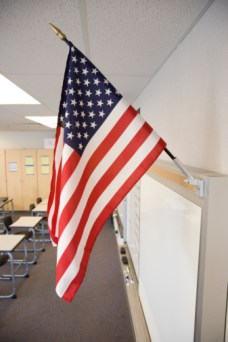
The Fourth of July has always been a favorite holiday of mine. The fireworks, the food, the abundance of red, white and blue, the obligatory History Channel marathon of something about the American Revolution; it all is precisely in this history teaching, America loving, BBQ enthusiast’s wheelhouse. The Fourth is the day where nearly all of our nation’s traditions and rituals are put on full display, and I hope that our students (and really all Americans) recognize the significance of this nation and the great responsibility placed in all citizens by the Founders.

During the annual fireworks display I always find myself taking a moment and reflecting with pride the origins of our nation and the principles in which we were founded. This opportunity to reflect is really the purpose of our national traditions, but too often we get so caught up in the hectic nature of 21st century life that the meaning gets lost. In terms of school, my mind immediately goes to the recitation of the Pledge of Allegiance by students of all ages. Those schools where this is a daily or weekly requirement display an admirable dedication to honoring America, but I hope the respective social studies teachers in those buildings take the time to remind their students of the magnitude of those words. The Pledge of Allegiance is a powerful act that strikes at the heart of what it means to be a voluntary, active member of our republic. However, without reflecting upon its meaning it can become an empty gesture that is done without meaning or significance. In my class I took a portion of a 45-minute class period to discuss with my kids the significance of the Pledge and what exactly they were doing as they have been reciting it for years.
Continue reading Teaching the Pledge: A Strategy for Using the Pledge of Allegiance to Promote Civic Discussion →

The NPS is 100 and giving away free stuff

every kid in a parkWith the end of the school year arriving, now is the time to plan your summer vacation. The National Park Service can help! The Park Service was established on August 25, 1916 and is celebrating its 100th anniversary by working to get “Every Kid in a Park.”

The program is simple. All fourth grade students and members of their family can get into national park sites for free during the entire year! Students can get their pass and plan their trips at the Every Kid in a Park site.

Visiting national park sites in Kansas is easy and it does not require a pass because there is no fee to get into any of the five national park sites in Kansas. Below is a list of NPS sites in Kansas:

If you are able to travel beyond the borders of Kansas, just take your park pass to any NPS site to gain free entrance into any national park!

You can go to Every Kid in a Park to discover how to get to some of America’s most treasured places, like Yellowstone in Wyoming or the Grand Canyon in Arizona, or some of the hidden gems of the Park Service, such as Rosie the Riveter WWII Home Front in California or the Chesapeake and Ohio Canal National Historic Park in Maryland. Whether you want to experience history, recreation, nature, or solitude, there is a national park for you.

Teachers shouldn’t forget the very cool Teaching with Historic Places that uses properties listed in the National Park Service’s National Register of Historic Places to enliven history, social studies, geography, civics, and other subjects. TwHP has created a variety of  lessons, products, and activities that help teachers bring historic places into the classroom.

So fourth graders, teachers, and parents take advantage of your summer break and visit your national parks through the “Every Kid in a Park” program!

Because no matter who you are, no matter where you live, our parks, our monuments, our lands, our waters — these places are your birthright as Americans.”

President Barack Obama

Enjoy Your Summer!

Nicholas Murray
Education Specialist
Brown v. Board of Education National Historic Site

6 C’s for analyzing primary sources

history project logo

Over the last few years, we’ve seen the instructional strategy pendulum swing over to encouraging more use of evidence by students to solve authentic problems. And there’s tons of stuff out there to help us and students make sense of primary and secondary sources.

You’ve got the Library of Congress primary source analysis worksheets. You’ve got the awesome stuff bySam Wineburg and Stanford. There’s the DocsTeach site by the National Archives as well as all of their document analysis lessons / worksheets. And lots of things like Historical Thinking Matters and Historical Scene Investigation.

But a lot of people don’t seem to be aware of the excellent work that the History Project at the University of California, Irvine does with helping student evaluate evidence. We have been perhaps overloaded with Wineburg’s stuff so much that we don’t think that we need to go out and look for other types of tools.

Don’t get me wrong, Sam. I absolutely love your stuff. Sourcing, contextulization, corroborating. I am all in. But we always said that it’s okay to date other people. And the History Project has some useful stuff.

I especially like their 6 C’s of Primary Source Analysis graphic organizer. Continue reading 6 C’s for analyzing primary sources →

It’s a Google World and I’m Just Teaching In It (Part 2)

Flubaroo_small_promo_440x280Building off of my last post about Google Forms, I want to introduce you to an add-on called Flubaroo which can turn your form into a self-graded quiz (yay for efficiency!).  The steps are very quick and simple, like most things in the Google universe, and is a great way to save some trees and implement technology in your classroom.

Continue reading It’s a Google World and I’m Just Teaching In It (Part 2) →

Most influential people of all time (US version)

A recent Time magazine article lists what it calls the 20 most influential Americans of all time. It’s an interesting list. Four presidents, two social activists, two women, assorted scientists and inventors, a couple of explorers, and an athlete and musician thrown in for good measure. Many famous, a few not so much.

And like the 100 most important American documents, open for debate. Why Steve Jobs and not that Microsoft guy? Why only two women? A boxer? Really? Continue reading Most influential people of all time (US version) →