Student Action: The Power Students Have To Make Change

Students around the nation are talking about the presidential election. I remember my middle school and high school days watching presidential elections and feeling a need to take part in some way, shape, or form. It was fun to have mock elections but I knew that those votes just stayed in the classroom and would not affect the actual vote tally. I would go home those nights watching the local news seeing the individual votes go up and up and up as the polls closed but knowing none of those votes were mine.

It made me feel powerless.

No matter who your students supported, many of them will feel that same powerlessness and want to take some form of action. As history educators, we can use examples of Continue reading Student Action: The Power Students Have To Make Change →
Graphic Content: Using Visual Communication in the Social Studies Classroom

imgresOne of my favorite ways to present information to students is through the use of infographics because they are visually appealing and easy to read, even though they can contain a wealth of information.  In the past I have been a huge proponent of not recreating the wheel when it came to infographics because it is so easy to search for a topic and find something that has already been created and can easily be used in the classroom.  That was until I was introduced to Piktochart, the easy-to-use infographics creator. Continue reading Graphic Content: Using Visual Communication in the Social Studies Classroom →
Congratulations to KCSS TOY Award Winners

Yesterday three outstanding social studies teachers were recognized at the annual Kansas State Social Studies Conferences for receiving the Judy Cromwell Excellence in Teaching Award.  Judy Cromwell taught social studies in the Topeka area for over 38 years. She was a long-time member of KCSS and served on the board for 28 years.

Judy was known for her strong support of classroom teachers, her delicious buffalo chip cookies, and for leading summer trips around the state with teachers. The Excellence in Teaching Award is named in her honor.  Intended to reward and encourage high quality instruction in the social studies for educators who are currently teaching social studies at least half-time and have three years teaching experience, KCSS selects one winner in each of the grade levels: elementary, middle, high school, and higher education.

This year nominations were received and winners were selected for the elementary, middle, and high school levels. Continue reading Congratulations to KCSS TOY Award Winners →

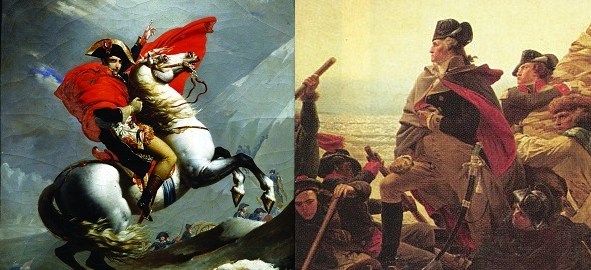
“The Anti-Washington”: Using Art as a Historical Tool in World History Class

I believe that a key aspect of “doing” social studies is to give kids the opportunity to not only connect prior knowledge to the content being studied, but also allow them the chance to reevaluate their opinion of historical figures using new knowledge that is presented.  Teaching high school world history normally involves introducing students to a wide range of individuals, concepts and events.  Trying to help students achieve some level of mastery of these concepts can seem daunting, especially if you are not able to tap into that reservoir of knowledge that the kids bring with them into the room.  In teaching the French Revolution and its aftermath I attempt to achieve this by bringing in the single historical figure in which kids are the most familiar: George Washington.  In the process I also give the students a chance to flex their non-text discipline specific literacy muscles by analyzing two pieces of art work that say an awful lot about the subjects of depicted in each.

Continue reading “The Anti-Washington”: Using Art as a Historical Tool in World History Class →

MBQs – Using Media Based Questions to support historical thinking

reece-1I was having a conversation with my two twenty-something children a few weeks ago and referenced an old Reese’s Peanut Butter Cup commercial. You know the one.

The one where two people, one eating peanut butter and the other chocolate, bump into each other? The one where they’re both heading headphones, listening to their Sony Walkmans, and don’t see each other until it’s too late.

“Hey! You got peanut butter on my chocolate.” “Hey! You got chocolate in my peanut butter.”

Yeah. My kids obviously didn’t remember either. It’s an ancient ad but I think of it often when we’re talking about app mashups and tweaking tech tools to do things they’re not really designed to do. Cause chocolate and peanut butter is as delicious together as is iMovie and Tellagami.

I shared the Reece’s reference with my kids because earlier in the day I had spent some time talking Google tools with a group of tech integration coaches. Part of that time was spent exploring the possibilities of mashing up Google My Maps and Forms. And over the last few days, my brain has been going back to different things that we could be doing with Google Forms.

So.

I love document based questions. I love the Stanford History Education Group’s Beyond the Bubble mini-assessment tool. And we know that I love the Google.

The mashup? Continue reading MBQs – Using Media Based Questions to support historical thinking →