Category Archives: historical thinking

4 reasons for not using primary sources (And 27 strategies for eliminating those reasons)

nokes book

I’ve cross-posted this article from History Tech because the article discussed below is just that useful. So . . . if you’ve already seen this, head back to the article and keep reading!

——–

As the discipline continues to shift its practice towards asking kids to solve problems using evidence and encouraging the development of historical thinking skills, more and more social studies teachers are integrating the use of primary sources into their instructional designs. Several days ago, I posted a quick overview that highlighted 10 things to think about while using primary sources.

And if you’ve been reading History Tech for any amount of time, you know that I love the use of evidence – especially the use of primary sources.

But what if we’re wrong?

What if using primary sources is so difficult that many of our students just aren’t able to do it? Could we just be wasting a bunch of time that would be better used with direct instruction? Continue reading 4 reasons for not using primary sources (And 27 strategies for eliminating those reasons) →

Hexagons? In History?

Students in Ms. Green's class using hexagons to refresh their memories and make connections to the curriculum.
Students in Ms. Green’s class using hexagons to refresh their memories and make connections.

I am trying to be more mindful of pulling my students’ learning through this year. You know, revisiting what they’ve already learned so it doesn’t fly out of their brains never to return (at least not to return until their high school American History teacher says they should have learned this in 8th grade and have to review it…).

I tried out a neat tool this week with my students that Glenn Wiebe showed the KCSS Executive Board over the summer. The ClassTools.net Hexagon Generator allows you to select up to 30 terms that will then be placed on little hexagons which you will then have the pleasure of cutting apart (good task for a student aide with time on her hands, wish I had one).

With only three days this week due to Parent-Teacher Conferences I didn’t want to jump into something new before their long weekend, so I decided to roll out the hexagons. I used a mix of ideas, people and events that we’ve covered since the beginning of the year. Each table got a set and my directions – if the terms on their hexagon have a connection they can touch, but for each side that touches there has to be a connection. Continue reading Hexagons? In History? →

A Guide to a New Type of Test

I got to know Jill Weber about five years ago when we started our second Teaching American History grant at ESSDACK. And she’s been great about opening up her classroom in a variety of ways including posting ideas and strategies on her blog A View of the Web.

Jill recently shared a post with our study group that she is allowing us to cross-post. Enjoy!

glennw

—————————-

My 7th graders will be taking their first test for me this week.  I thought this would be a good time to talk about what a Social Studies test in Mrs. Weber’s class looks like.

Social Studies has changed.  Teachers should be implementing activities, lessons, and strategies to help students read and analyze primary sources, think critically, and “do” history.  We should be teaching kids how to become historians.  How to question sources, look at conflicting view points, and draw conclusions based on the evidence that is given to us.

But what does that LOOK LIKE?

And what does it look like on a TEST?

I have spent the last three years developing a method for creating unit tests/assessments that involve more analysis and application as opposed to simple regurgitation of facts.

Here’s a taste of what you will and won’t see on one of my tests. 
Continue reading A Guide to a New Type of Test →

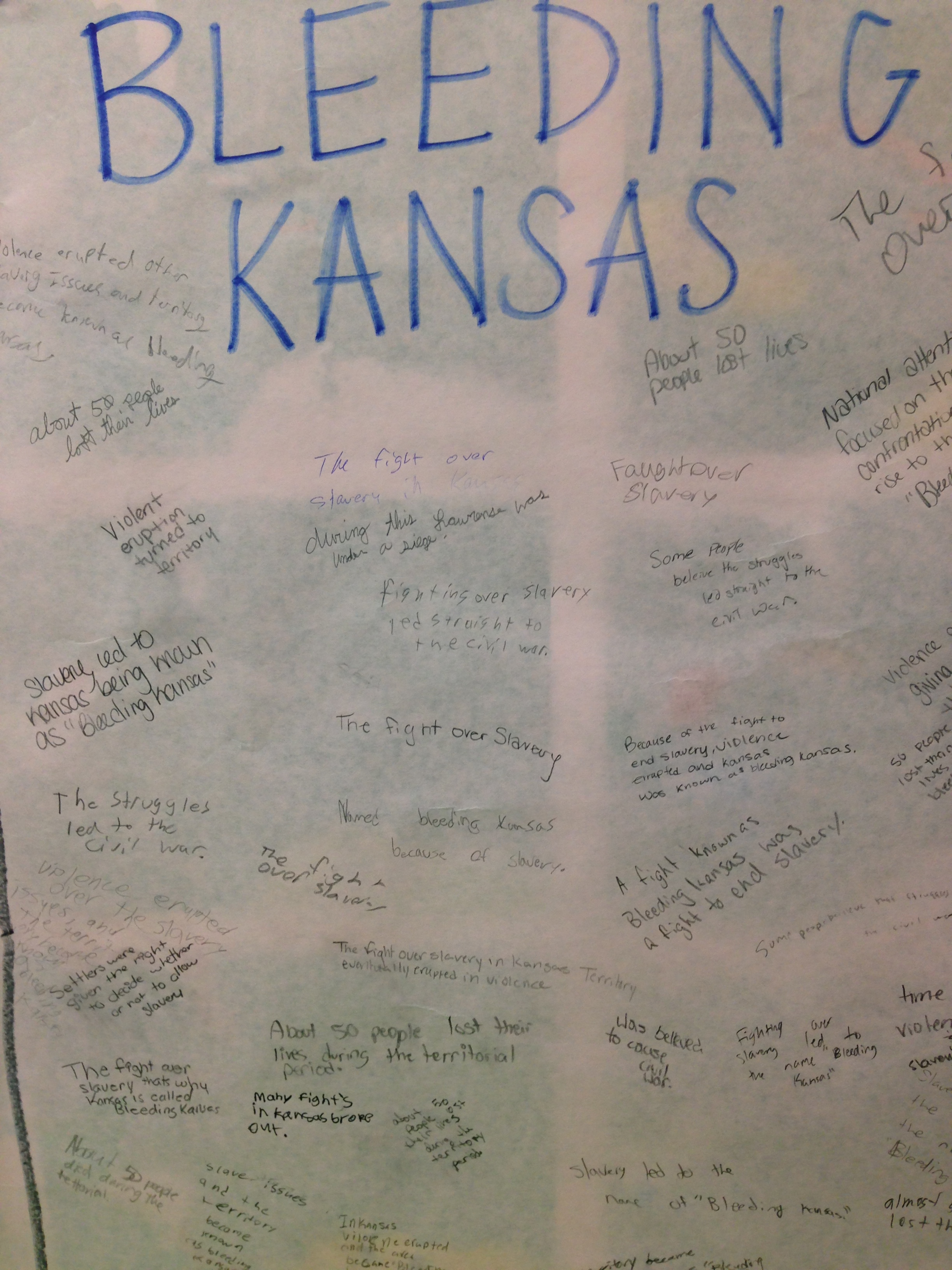
“Was Kansas Actually Bleeding?”

Bleeding Kansas

One thing I have learned as a teacher, kids really do say the darndest things!  Recently my Kansas History class started in on Bleeding Kansas, and I realized that very few of my students had retained any prior knowledge on the subject.  To get the students interested in the topic, and to provide them with some basic knowledge before we really got started on the topic, I planned a pre-reading strategy using key words from the Bleeding Kansas chapter in our Kansas Journey textbook.  Continue reading “Was Kansas Actually Bleeding?” →

Trans-Atlantic Slave Trade Database

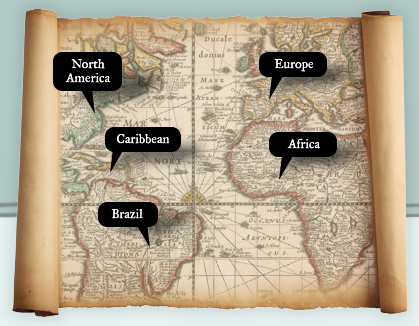
slavery databaseHaving students internalize historical events is a task I try to achieve in my high school Geography and World History classrooms almost every lesson. This is a difficult mission, but it does not prevent me from asking myself, “How can I make this topic personal for students?”

This is the same question I pondered when developing lessons about the Trans-Atlantic Slave Trade. Yes, students arrive to me with prior knowledge about the subject, but their familiarity with the topic is only surface-deep. I have learned that investigating history from the bottom-up has made my students more attuned into the field of history.

Therefore, the Trans-Atlantic Slave Trade Database has made the grassroots of this theme come alive in my classroom. The immense about of information compiled in this database is astounding and truly makes my students appreciate the subject. There are maps that illustrate where the 12.5 million slaves were embarked and disembarked, but what catches my students’ interest the most is the “African Names Database”, which houses 91,491 names of Africans who were enslaved. Not only are their names provided, but also their age, height, sex, name of the ship they were transported on, and where they were embarked/disembarked.

By clicking on the “Voyage ID” for each African listed, you can even see more information about the ship, such as its tonnage and the name of the captain! This is a treasure-trove of information that makes the Trans-Atlantic Slave Trade relevant to students.

The site even offers lesson-plans for teachers, who may want to know how to incorporate this information into the classroom effectively. The slave-trade may have ended over a century ago, but this database helps students realize the significance of this event.